The "Big Bang" is one of the most recognized terms in science — and one of the most misleading.
Coined in 1949 by astronomer Fred Hoyle, the phrase was meant as a dismissive nickname, not a scientific description. The reality it refers to is not a single explosion in the past but an ongoing process: the expansion of space itself, still happening right now.
What People Mean by "Big Bang"
- About 13.8 billion years ago, the universe was in a much hotter, denser state.
- Space has been expanding since then, and continues to do so.
- Observations that support this:
- Redshift — galaxies moving away from each other.
- Cosmic Microwave Background — uniform radiation from ~380,000 years after expansion began.
- Element ratios — predicted and observed hydrogen, helium, and lithium match.
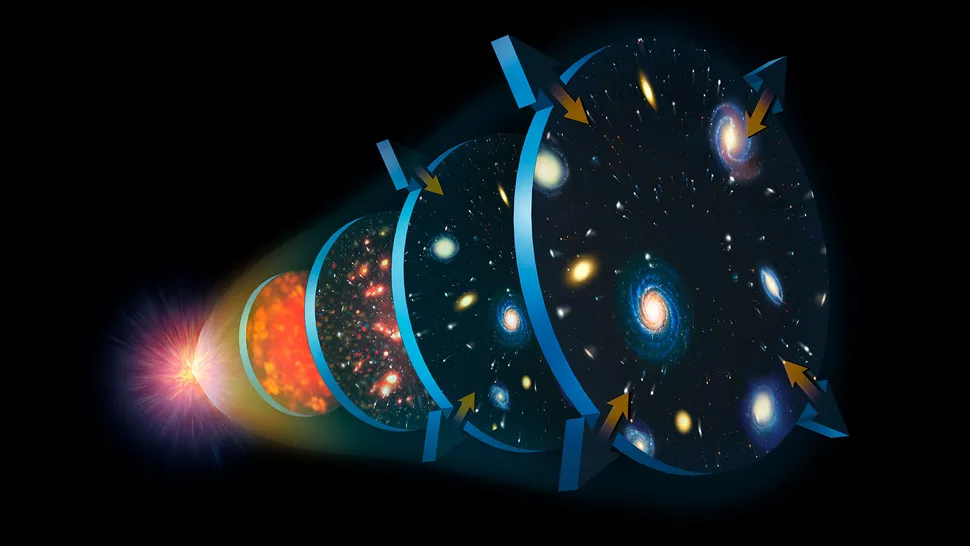 Image credit: Science Photo Library/Getty
What It Is Not
- Not an explosion in preexisting space.
- Not necessarily the origin of all reality.
- Not proof for or against any deity.
- Not the same as "something from nothing."
Why the Term Is Misleading but Useful
- "Big Bang" suggests a single, finished event.
- The expansion is still occurring — we live inside it.
- Using the term correctly means understanding it as shorthand for ongoing universal expansion.
Current Questions Science Hasn't Answered
- What happened before the first measurable moment? Unknown.
- Is the universe finite or infinite? Unknown.
- Did expansion have a beginning or is it part of a cycle? Still under study.
The "Big Bang" will probably always be the public's label for the universe's early expansion. Used carefully, it can point to the remarkable reality we're still experiencing: a universe in motion, measured with precision, and open to further discovery.